
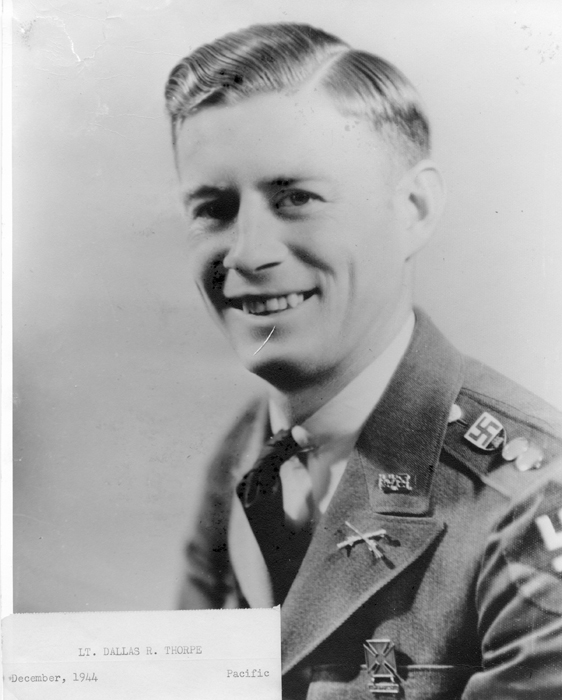
Lieutenant Joseph Dallas Thorpe
Joseph Dallas Roof Thorpe was born January 27, 1915 to Dr. Byron and Elizabeth Thorpe. Raised in Tucumcari, he graduated from Tucumcari High School in the spring of 1933 and enrolled at NMAMC the next fall. In 1937 he left after studying Mechanical Engineering. He came back to school in the spring of 1939 for another semester as a senior but never returned to complete his degree. In 1940 he was living at home in Artesia with his parents, employed as an engineer.
In the spring of 1940, the 111th Cavalry of the NM National Guard was converted to the 200th Coast Artillery Regiment and on January 6, 1941, he and the other members were inducted into federal service and immediately sent to the Anti-Aircraft Training Center at Fort Bliss, Texas.
In July 1941 he married Fay Jewell. In August, the 200th CA was dispatched to the Philippines.
On December 8, 1941, only nine hours after the Japanese attack of Pearl Harbor, the 200th CA engaged Japanese bombers at Clark Field and Fort Stotsenberg, becoming the first unit to go into action in defense of the U.S. flag in the Philippines. On April 9, 1942, the weakened survivors from the combined American and Filipino forces were unconditionally surrendered to the Japanese.
Most POWs were assembled in Mariveles at the southern tip of the Bataan peninsula and forced to march to San Fernando, Pampanga. Wounded men were assisted by able-bodied prisoners or carried on crude stretchers. Stragglers were beaten or killed. Civilians who showed mercy to the prisoners endured a similar fate. The incident covered a distance of 104 kilometers (65 miles) and became known as the Bataan Death March.
Imprisoned as a POW for years, he was picked in December of 1944 to be transported to Japan for slave labor.
On the morning of December 13, 1,619 POWs boarded the Oryoku Maru, bound for Takao, Formosa, and Moji, Japan. On the morning of December 14, the convoy was attacked by US warplanes. The POWs endured seventeen such attacks before sunset. Only Oryoku Maru remained afloat. On the morning of December 15, U.S. Navy aircraft sank the Oryoku Maru near Olongapo Naval Station, Subic Bay, Luzon. Surviving prisoners were assembled nearby at some tennis courts. Of the 1,619 POWs aboard the "hell ship," as they termed it, only 1,290 answered roll call.
On December 27, the surviving prisoners boarded the Brazil Maru and Enoura Maru and sailed for Takao, Formosa. The ships docked there on New Year's Day 1945, and the prisoners received their first food since leaving San Fernando, On January 9, MacArthur's forces invaded Luzon. A simultaneous attack was made on Takao and both ships again came under US fire. On January 14, 1945 the remaining survivors were placed in the holds of the Brazil Maru and sailed for Moji Japan. When it arrived in Moji it is reported that only 430 of the original 1,619 prisoners that boarded the Oryoku Maru were still alive. More died in the following days from exposure.
Lieutenant Joseph Dallas Roof Thorpe suffered, as did all his fellow prisoners, untold horrors and treatment at the hands of the Japanese prior to his death, which is reported as January 27, 1945. He was buried at sea and is memorialized on the Manila American Cemetery Tablet of the Missing. He was one day shy of his 30th birthday at the time of his death.
Historical Source: Bataan Memorial Park in Albuquerque, New Mexico. Jack W. Bradley, 515th Coast Artillery, who, despite a debilitating illness, wrote the history — engraved on three of the columns