
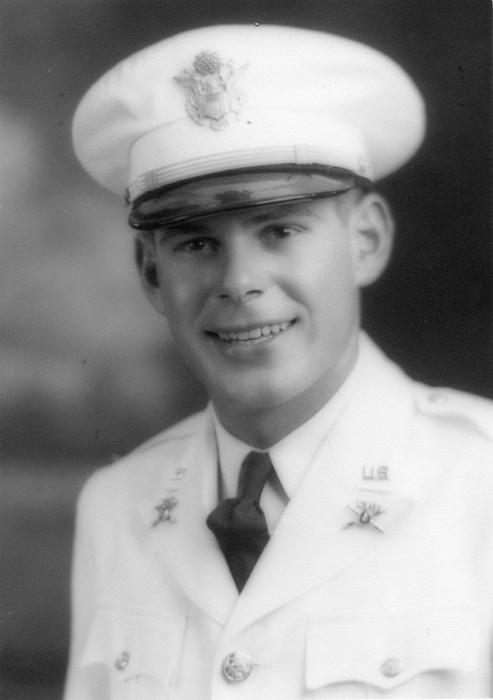
Lieutenant Robert John Remondini
Robert John Remondini, son of Joseph and Mary Remondini was born in Deming NM on June 20, 1919 and raised on his family’s farm just outside of town. After graduating from Deming HS in 1937 he attended NMAMC for two years studying Engineering.
In the spring of 1940, the 111th Cavalry of the NM National Guard was converted to the 200th Coast Artillery Regiment and on January 6, 1941, he and the other members were inducted into federal service and immediately sent to the Anti-Aircraft Training Center at Fort Bliss, Texas. In August, the 200th CA was dispatched to the Philippines.
On December 8, 1941, only nine hours after the Japanese attack of Pearl Harbor, the 200th CA engaged Japanese bombers at Clark Field and Fort Stotsenberg, becoming the first unit to go into action in defense of the U.S. flag in the Philippines. That evening, 500 soldiers from the original regiment of 1800 men were sent to provide additional air defense in Manila. This provisional force was christened the 515th Coast Artillery and became America’s first war-born regiment in World War II. Lt Robert Remondini was assigned to the 515th.
The final leg of the northward journey was completed inside stifling railway boxcars that took them to the prison set up at Camp O’Donnell. . Most of the American POWs were eventually transferred to Cabanatuan. The captured soldiers were subjected to inhumane conditions. Death from malnutrition, disease and abuse was a common occurrence. More than 4,000 American POWs and 25,000 Filipino POWs died in these two camps alone.
At some point Remondini was shipped to Camp No. 2, at Davao, Mindanao. After being assigned as part of the LaSang airfield detail and with American forces nearing the islands, Lt Remondini and 750 others were marched shoeless to the Tabunco pier on August 19, 1944. On August 20, 1944 they were crowded into the holds of the Erie Maru. Late in the afternoon of August 24, the ship arrived in Zamboanga harbor on the southwest corner of Mindanao. After ten days of waiting in the harbor, still subject to occasional allied air attacks, they were transferred to the Shinyo Maru on September 4 and on September 5 the Shinyo Maru left harbor taking a zig zag path up the western coast of Mindanao as part of a convoy of seven ships.
Awaiting the convoy of Japanese ships was the USS Paddle who had been informed that the Shinyo Maru carried Japanese troops. Late in the afternoon of September 7, 1944 the submarine found its prey and fired two torpedoes that both hit amidships. As the survivors attempted to flee the holds they were fired upon by Japanese machine guns from both the Shinyo Maru and the other ships nearby. Thirty those that did make it into the water and then gave themselves up to a Japanese patrol boat were executed with a shot to the back of their head the next day for attempting to escape. Of the 750 allied prisoners on board the ship, only 83 survived to swim to shore and were rescued by Philippine guerillas operating in the area.
Lt Robert John Remondini was 25 years of age. He is memorialized on the Manila American Cemetery Tablet of the Missing. He was the brother of Jody McSherry and brother in law of GX McSherry. Their granddaughter Erin McSherry would serve as President of ASNMSU.
Historical Source: Bataan Memorial Park in Albuquerque, New Mexico. Jack W. Bradley, 515th Coast Artillery, who, despite a debilitating illness, wrote the history — engraved on three of the columns