
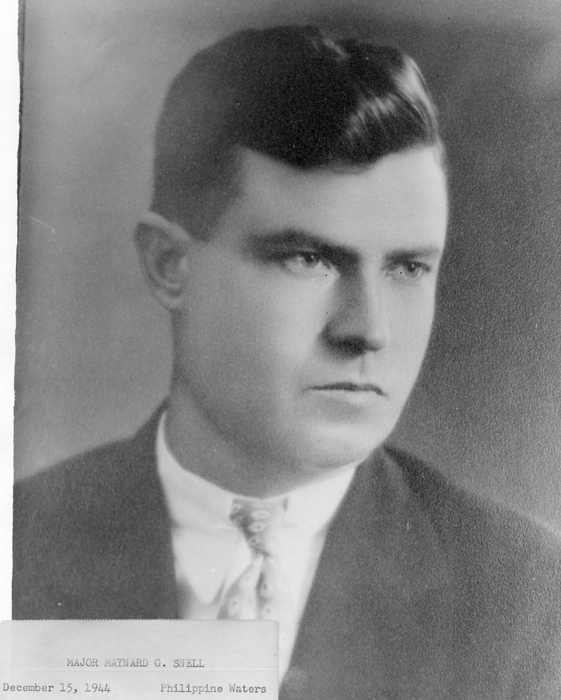
Major Maynard G Snell
Maj. Maynard G. Snell was the son of Benjamin Snell & Mattie E. Goldman-Snell and was born in 1901. It is known that he grew up with his brother and sister in Lampasas, Texas. After high school, he attended Texas A&M College and earned a Bachelor of Science degree in 1921. He next attended the University of Missouri where he acheived his Masters. He then attended New Mexico College of Agriculture and Mechanic Arts for 2 years of post-graduate work prior to enrolling at Iowa State University where he received his PhD.
Snell became a college professor and served on the faculty of Louisiana State University. At the same time that he was teaching, he served in the Army Reserve. He worked at Louisiana State University until February 26, 1941, when he was called to active duty in the army.
At Fort Benning, Georgia, Snell attended Officers Training School. Upon completion of this program, he was sent to Camp Bowie, Texas. It was from there that he was sent to Angel Island in San Francisco Bay to join his new unit, the 192nd Tank Battalion. He became the Executive Officer of the battalion
On November 3, 1941, from Angel Island, Snell and the battalion sailed to Manila. After stops in Hawaii and Guam, the battalion arrived in the Philippine Islands on Thanksgiving Day, 1941. A little under two weeks later, Maj. Snell lived through the Japanese attack on Clark Field. On December 8, 1941, 54 Japanese planes appeared over Clark Field and wiped out the American Army Air Corp. Over the next several days, he witnessed the repeated attacks by Japanese planes as they attempted to wipe out the American forces on the Island of Luzon.
During this time, Snell mentioned in a letter home that he had been assigned as a liaison officer to Gen. MacArthur's staff. The envelope that the letter came in appeared to be homemade. Although in this role he never saw action, he did have the job seeing that the tankers received the necessary food and other supplies so that they could continue to fight.
Snell continued to work so that the Filipino and American troops on Bataan could continue the fight against the Japanese. On April 9, 1942, Maj. Snell and the other troops learned that they had been surrendered to the Japanese. It was from Mariveles, that Snell began what would become known as the Bataan Death March.
Snell was held as a POW at Camp O'Donnell. He was next sent to Cabanatuan POW Camp and remained there from June to October, 1942. After his time at Cabanatuan, nothing is known of his life as a POW until he arrived at Bilibid Prison in the late 1944. It was while there that he received a physical and declared to be healthy by the Japanese. This meant he would be sent to Japan.
On December 13, 1944, Major Maynard Snell was boarded onto the Oryoku Maru with 1600 other Prisoners of War. The POWs were crowded into the hold of the ship. Since the prisoners would not stop their screaming, the Japanese proceeded to cover the hatch creating a living hell for the men inside. Not only was the heat unbearable, but the smell from the human waste made the atmosphere stifling.
It was during the night of December 13th, that Major Maynard G. Snell collapsed and died in the rear hold of the ship. After his death, his body was thrown overboard. His name appears on the Tablets of the Missing at the American Military Cemetery at Manila. He was 44 years of age at the time of his death.
Main Source: http://www.proviso.k12.il.us/bataan%20web/Snell.html